Tbilisi Art Fair 2026: What Contemporary Art in Georgia Looks Like
Tbilisi Art Fair 2026 once again confirmed its status as one of the key platforms for contemporary art in the region, bringing together artists, galleries, and independent initiatives from Georgia and beyond. Our editorial team visited the fair, explored the exhibitions, and spoke with participants across the booths about current artistic processes, the local scene, and its ongoing transformations.
Tbilisi Art Fair is an annual contemporary art fair held in Tbilisi since 2018, and over the years it has become an important point of intersection between local and international art contexts. In 2026, the fair continues to develop its format as a space for dialogue between institutional galleries, independent projects, and emerging artistic initiatives.
This year’s participants include galleries and platforms that shape a current cross-section of the scene: LC Queisser, Window Project, Gallery Artbeat, among others. Each of them offers its own perspective on how contemporary art can be structured and presented today — ranging from painting and sculpture to installation, video, and interdisciplinary practices.
Particular attention is traditionally given to sections that extend beyond the classical gallery format. Within the special projects, independent artistic collectives and curatorial initiatives are presented, working with more experimental formats and process-based practices. Here, a clear shift can be observed — from the object to the process, from the finished artwork to the ways it is produced and documented.
In the 2026 presentations, several consistent directions emerge: engagement with local identity and its recontextualization, exploration of memory and archival materials, as well as attention to corporeality, vulnerability, and social tensions. Alongside this, there is a growing interest in digital media, hybrid forms, and practices situated at the intersection of visual art, performance, and everyday life research.
A particularly notable aspect is the dialogue between generations of artists — from already institutionally recognized figures to younger practices working with more fragile, processual, and often ephemeral forms. This creates a sense of a scene in a state of active transformation, where no single dominant visual language exists, but rather multiple parallel strategies of expression.
In this sense, Tbilisi Art Fair 2026 functions not only as an exhibition event but also as a space for observing how contemporary art in Georgia is being shaped today — at the intersection of local experience, global artistic tendencies, and the individual research practices of artists.

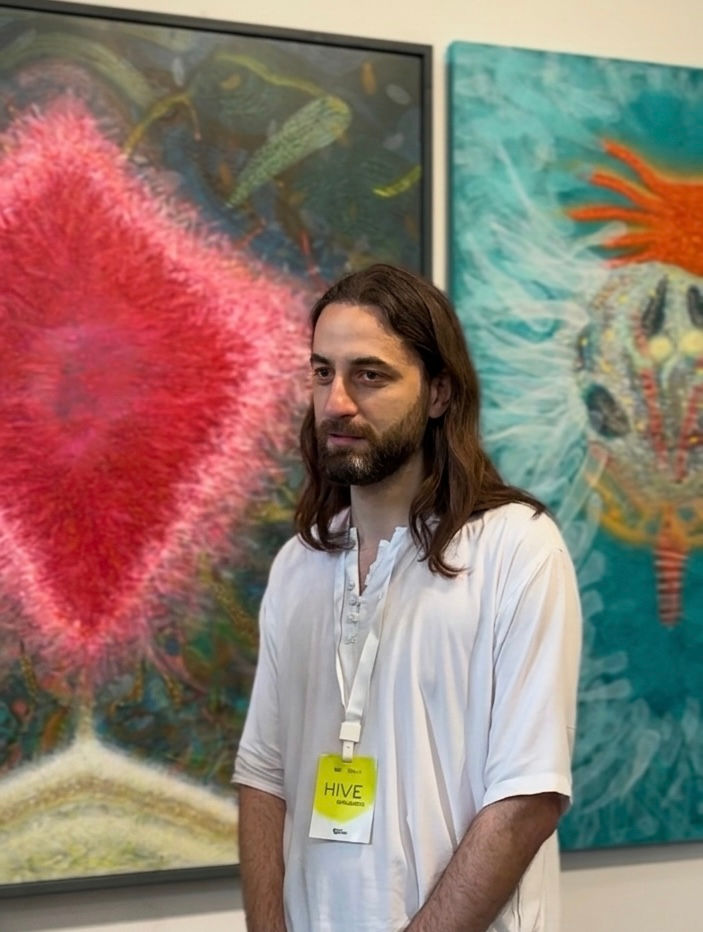
Gela Patiashvili: Animals as the Language of the City and a Return to Tbilisi
As part of Tbilisi Art Fair 2026, we spoke with artist Gela Patiashvili, whose practice spans painting and sculpture and unfolds across several intersecting directions.
A central place in his work is occupied by the theme of animals, particularly dogs. “The theme of animals — the theme of dogs,” the artist notes, emphasizing that this motif runs through different media. Sculpture is also an important part of his practice: in Tbilisi, three of his works depicting stray dogs are installed in the Red Park area.
Patiashvili was born in Tbilisi, later lived in France for over ten years, and eventually returned to Georgia. “A few years ago, I returned to teach, and mostly my projects shifted here,” he says, describing his return to the local context and the shift of his practice back to Tbilisi.
His works have been presented in various institutions across the city, including the Tbilisi History Museum, the Museum of Literature, and the National Gallery of Georgia. Among his recent projects, the artist also mentions his involvement in preparations for a potential presentation at the Venice Biennale within the Georgian Pavilion.
In terms of technique, Patiashvili works with mixed media, using pigments and oil. “As for the technique, it's a mixed technique using pigments and oils,” he explains, adding that his practice focuses on creating new images and characters emerging from observation and artistic reinterpretation.
At the time of the conversation, the artist’s solo exhibition was in preparation and scheduled to open at the end of the month.

Mari Ataneli: Body, Boundaries, and Performance
At Tbilisi Art Fair 2026, we spoke with dancer and choreographer Mariam Antoneli, whose practice combines contemporary dance, video, and installation.
Her current work presented at the fair merges video art with a live installation. “It’s video art combined with a live installation,” she explains, noting that the video captures a performance, while the rope structure extends the movement into space.
The project explores the idea of boundaries and self-imposed constraints. “It’s an exploration of human interaction with boundaries,” Antoneli says. “The performance shows how we build cages around ourselves and try to break free.”
A key focus of her practice is the body under pressure and transformation through restriction. The current version of the work, including the live installation element, is being shown for the first time at Tbilisi Art Fair.
The artist plans to further develop the concept into a full-length performance integrating dance, digital media, and architectural space.

Giorgi Qavtarashvili: Material Energy and the Viewer’s Gaze
At Tbilisi Art Fair 2026, we spoke with artist Giorgi Qavtarashvili, presenting two works at this year’s edition.
The pieces are executed in a combination of acrylic and tempera. “Today, I have two of my pieces on display here. They are created using a combination of acrylic and tempera,” the artist notes, pointing to a material language that remains central to his practice.
For Qavtarashvili, the exhibition context itself becomes part of the work’s activation — through its encounter with the viewer. “It’s very interesting. It’s fascinating to observe how the energy I put into these works reflects on other people, how they perceive it, and how that connection is made,” he says. “It’s truly interesting to watch.”
This emphasis on perception extends into a broader interest in circulation and visibility, both locally and internationally. “Both, really. I am interested in international exposure as well as local,” he adds, situating his practice between different contexts of presentation.
His works can be followed across multiple platforms and spaces: “You can find my works on my personal Instagram, as well as on various international art platforms like Artsy, in my studio, and right here at the Tbilisi Art Fair.”
Tatyana Chebysheva: Sensory Experience, Environment, and the Act of Seeing
At Tbilisi Art Fair 2026, we spoke with artist Tatyana Chebysheva, whose project “Sensory Experience” transforms the exhibition space into an immersive environment.
“I am Tanya. By my second education, I am an artist, a graphic artist. This project… it’s more of an environment. It’s not just about graphics,” she explains, framing her practice beyond a single medium.
The project invites the viewer into an interactive installation. “The title of the project is ‘Sensory Experience.’ I invite the visitor to enter this environmental space and interact with the installation,” she says.
At its core, the work reflects on the relationship between humans and the natural environment. “It’s not exactly a project about trees and the forest, as it might seem at first. It’s more about us, about people,” Chebysheva notes. “Because just like the trees in a forest, we also have skin, they also have skin, right? We also have roots, they also have roots. And we feel the influence of the environment on ourselves just as they feel it on them.”
A key conceptual gesture in the installation is the inversion of natural structures. “I intentionally moved the root system to the top, because in our lives, what is unseen is often more important than what is seen,” she explains.
The work is also designed as a sensory and participatory experience. “A visitor can interact as much as their inner freedom allows them to,” she says. “They can put on headphones… and enter the environment and interact with it.” The soundscape is created by sound artist Rustem Imameev.
Beyond exhibition contexts, the artist is interested in how the work circulates and affects viewers over time. “What matters more is that I’m observing how this project affects people,” she says. “People come back like five times. They just return, stand there, and look.”
She adds that viewers often reconnect with the work long after first encountering it: “They saw it back in 2021, and now they send me pictures saying, ‘Sorry for the spam, I couldn’t help myself. Look at this beauty.’”
For Chebysheva, this process is closely tied to perception itself. “A person can learn to see. We learn this. And through courage as well,” she reflects.
It seems like you might be referring to the Arial font. If you have specific questions or need information related to Arial or fonts in general, please provide more details!


Comments